The EU AI Act and Agentic Commerce: Why Unified Commerce Platforms Cannot Ignore Article 50
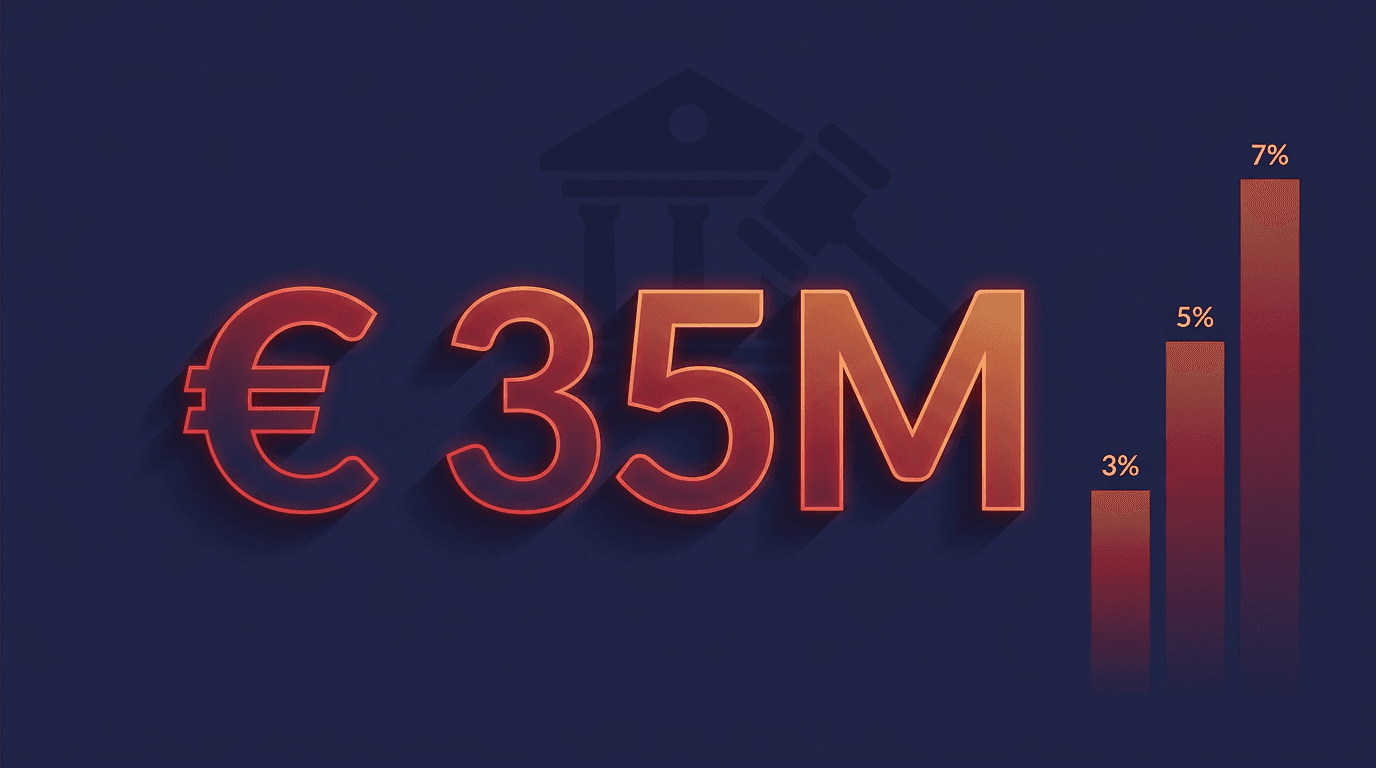
The EU AI Act requires AI systems that directly interact with consumers to disclose they are not human. For unified commerce platforms operating across 35+ countries - and the enterprise retailers they serve - Article 50 creates a compliance obligation across every AI agent that engages consumers in direct, synchronous interaction. Enforcement begins August 2026, with transparency violations carrying fines of up to EUR 15 million or 3% of global turnover, whichever is higher.

The EU AI Act is the most comprehensive AI regulation in the world. It entered into force in August 2024, with a phased enforcement timeline that reaches its most commercially relevant provisions in August 2026. For businesses deploying AI agents in consumer-facing commerce - particularly unified commerce platforms that serve enterprise retailers across the European Union - the transparency obligations in Article 50 are not peripheral. They sit at the centre of how agentic commerce operates at scale.
The core requirement is specific: AI systems designed to directly interact with natural persons must inform those persons that they are interacting with an AI system. The key word is "directly." The obligation is triggered by synchronous, conversational engagement - where the consumer is actively interacting with an AI system. A chatbot that answers customer questions is in scope. A conversational virtual assistant at a self-service kiosk is in scope. An email autoresponder, a content recommendation algorithm, or a spam filter is not - these are non-conversational systems where there is no direct, synchronous interaction with the consumer.
For a commerce platform whose AI-driven chatbots, conversational assistants, and interactive self-service kiosks are deployed across hundreds of retail sites in the EU, this distinction matters - but it does not narrow the problem as much as it might appear. Agentic commerce is conversational by nature. The agents that interact directly with consumers - brand agents, shopping assistants, customer service agents, loyalty chatbots - are the growth vectors of the entire model. These are the systems the platform is investing in most heavily, and they are precisely the systems Article 50 catches.

What Article 50 Requires
Article 50 establishes four categories of transparency obligation. The first is the most commercially significant for agentic commerce:
AI interaction disclosure
Providers must ensure that AI systems intended to interact directly with natural persons inform those persons they are communicating with an AI system - unless this is obvious from the perspective of a reasonably well-informed, observant and circumspect person, considering the circumstances and context of use.
AI-generated content marking
Providers of systems generating synthetic audio, image, video, or text must mark outputs in a machine-readable format and ensure they are detectable as artificially generated or manipulated.
Emotion recognition disclosure
Deployers of emotion recognition or biometric categorisation systems must inform exposed individuals of the system's operation and the categories of personal data being processed.
Deepfake disclosure
Deployers using AI to generate or manipulate content that constitutes a deepfake must disclose that the content has been artificially generated or manipulated.
Why Commerce Platforms Face Amplified Liability
The EU AI Act does not distinguish between a retailer running a single AI chatbot and a unified commerce platform deploying AI-driven systems across hundreds of enterprise retail sites. But the compliance surface is radically different.
Consider a platform that powers point-of-sale, self-checkout, back office, supply chain, loyalty, and conversational AI as a unified, modular suite - deployed across grocery, convenience, fuel, and specialty retail in 35+ countries. Not every AI system in the stack falls under Article 50. Predictive analytics for labour scheduling or shrink detection, running in the back office with no consumer interaction, are outside scope. But the conversational agents are squarely inside it: the AI assistant that helps a consumer at a self-service kiosk, the chatbot that handles customer service queries, the loyalty agent that engages shoppers with personalised offers through direct dialogue. These are the systems the platform is scaling most aggressively - and they are the systems Article 50 was written for.
The compliance question is not "does our AI chatbot identify itself?" It is: "across every AI agent that directly interacts with a consumer on our platform, deployed at every retail site in the EU, can we demonstrate that every system engaging in direct dialogue has properly disclosed its nature?"
The Cross-Boundary Compliance Challenge
The challenge a unified commerce platform can solve internally - ensuring its own AI systems comply with Article 50 - is only half the problem. The harder challenge is what happens when AI agents cross organisational boundaries.
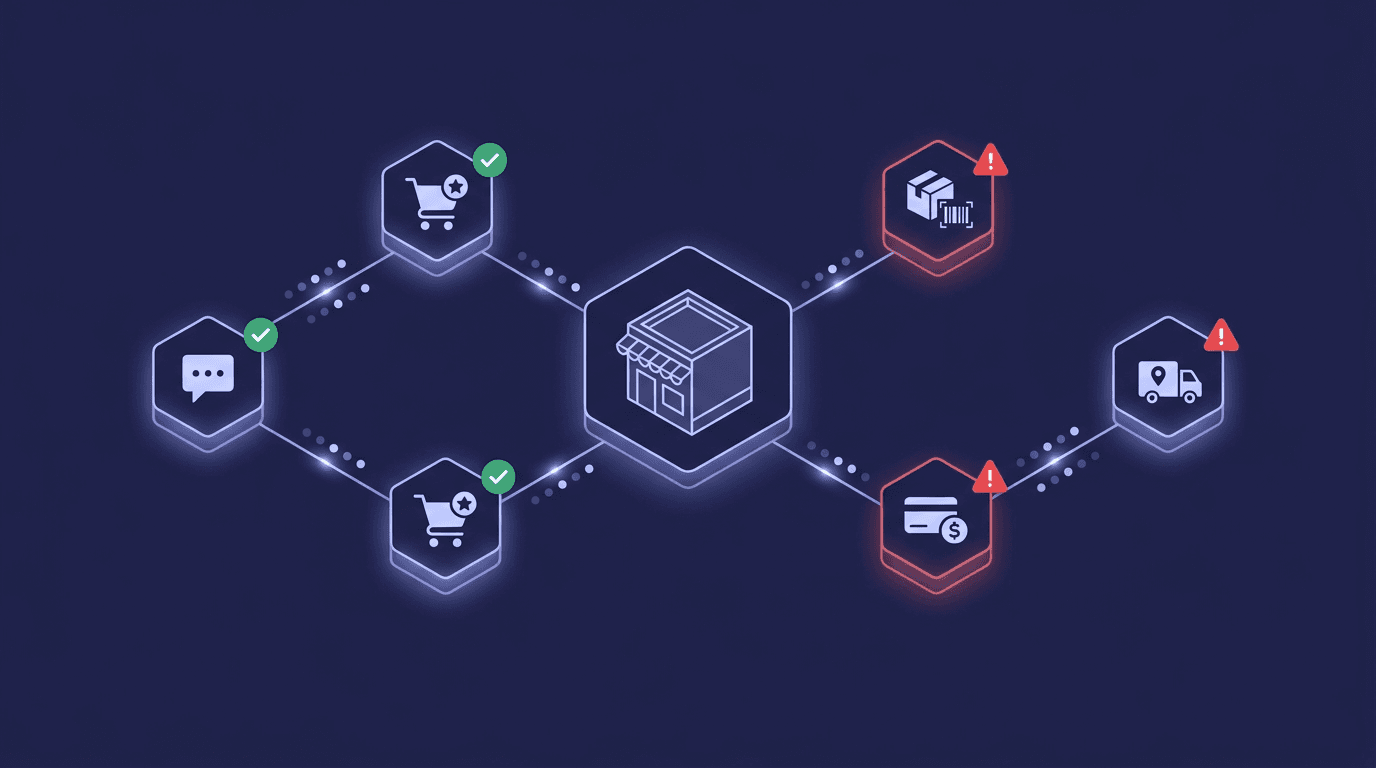
Agentic commerce is not contained within a single platform. A consumer's AI assistant contacts the retailer's brand agent. That brand agent checks inventory with a supplier's stock agent. A CPG brand's promotional agent pushes a live, verified offer to the checkout agent. A loyalty provider's offer engine personalises the interaction by basket. A payment agent processes the transaction. A logistics agent arranges fulfilment. An external AI shopping surface - a consumer searching through an AI mode interface - queries for "nearest convenience store with oat milk in stock" and needs a verified, machine-readable data source.
That is six or seven AI agents from different organisations involved in a single commerce interaction. Not all of them directly interact with the consumer - the inventory agent and payment agent may operate entirely in the background. But the ones that do - the consumer's AI assistant, the brand agent, the customer service agent - must identify themselves as AI under Article 50(1). And agents that generate synthetic content consumed by the consumer (product descriptions, delivery notifications) may trigger Article 50(2)'s marking obligations separately. The compliance surface is not a single platform - it is an ecosystem of agents that cross organisational boundaries at machine speed, where the scope question must be answered for each agent in the chain.
CPG brand agent interactions
When a CPG brand's pricing or promotional agent communicates through the commerce platform to reach the retail checkout, the platform must verify that agent's identity and ensure the interaction chain maintains Article 50 compliance. Without a neutral trust layer, every CPG-to-retailer agent connection requires bilateral integration - slow, brittle, and unauditable at scale.
External AI shopping surfaces
One in three Gen Z consumers now prefer AI platforms over traditional search engines for product research, and AI-driven traffic to US retail websites increased 4,700% year-over-year between 2024 and 2025. When external AI agents query for real-time stock, pricing, and fulfilment data, the commerce platform must expose verified, agent-readable data. Without registered agent identities, retailers on the platform are invisible to AI-native discovery - and the interactions that do occur cannot be traced for compliance.
Cross-retailer agent interoperability
Enterprise retailers on the same platform each have their own growing AI agent ecosystems. When those agents need to communicate through the platform layer - supplier pricing queries, cross-brand loyalty redemption, shared supply chain data - there is no shared protocol. Every connection is bespoke, and every bespoke connection is a compliance gap.
The “Know Your Agent” Problem
McKinsey and Visa have both publicly identified the same unresolved challenge in enterprise agentic commerce: agent identity. Visa launched its Trusted Agent Protocol in October 2025 specifically to address it. When an AI agent initiates a transaction, queries a system, or interacts with a consumer, how does the receiving party know who that agent is, who it represents, and what it is authorised to do?
Article 50 of the EU AI Act codifies this as a legal requirement. But the Act only mandates disclosure - it does not prescribe the infrastructure that makes disclosure verifiable. A text string that says "I am an AI" satisfies the letter of the requirement. But when the regulator asks "can you prove that every agent in this multi-organisation interaction chain properly identified itself?" - a text string is not evidence.
The "Know Your Agent" problem is the identity gap: a commerce platform can issue its own agent identifiers internally. It cannot issue verified identities that external agents - a CPG brand's pricing agent, a consumer's AI shopping assistant, a retail partner's fulfilment agent - will recognise and trust. And without that trust, there is no auditable compliance chain.
How Agentverse Enables Compliance at the Infrastructure Level
A commerce platform can mandate disclosure for its own AI systems. That is an internal engineering problem with an internal engineering solution. The harder problem - the one no platform can solve alone - is cross-organisational. When a CPG brand's promotional agent needs to communicate with the platform's checkout agent, there is no shared identity standard between them. When a consumer's external AI assistant queries for product availability, it has no way to verify that the responding agent is legitimate. When a supplier's fulfilment agent triggers a stock transfer, neither party can cryptographically prove who initiated the action. Every one of these cross-boundary interactions requires identity infrastructure that sits outside any single organisation's control. No platform can issue identities that external parties will trust, because the platform is not a neutral party.
This is the specific problem Fetch AI's Agentverse and Almanac registry were built for. The Almanac is an on-chain, decentralised registry - not owned or controlled by any single platform, retailer, or CPG brand. Agents from any organisation register with a cryptographically signed identity. Any agent can query the Almanac to verify any other agent's identity before exchanging data. There is no bilateral integration per connection - a retailer that integrates with the Almanac once is discoverable and verifiable by every agent on the network. The integration cost is constant, not exponential. And because no single party controls the registry, every participant - retailer, CPG brand, consumer AI assistant, logistics provider - trusts it equally.
Cryptographic agent identity via the Almanac
Every agent registered on Agentverse carries a cryptographically signed identity on the Almanac - a blockchain-verified address that establishes who the agent is and what protocols it supports. Registration requires proving ownership via cryptographic signature. When an external AI agent queries the commerce platform, it can verify via the Almanac that it is speaking to a registered, authenticated agent - not a spoof. This is the 'Know Your Agent' infrastructure that Article 50 compliance demands.
Multi-party discovery without bespoke integration
The Almanac is a tamper-proof registry of verified agent identities. When any agent - a consumer's AI assistant, a CPG brand's promotional agent, a regulator's audit tool - queries the Almanac, it gets a verified answer. No bilateral integration per external system. The integration surface does not grow exponentially as the agent ecosystem expands.
Agent-to-agent protocol with identity built in
Agentverse's agent-to-agent communication uses structured message protocols where agents are identified by their Almanac-registered addresses. Before agents exchange data, the receiving agent can verify the sender's identity against the Almanac's on-chain registry. Disclosure is not an afterthought bolted onto the conversation - agent identity is a first-class property of the infrastructure. When a retailer's checkout agent communicates with a CPG brand's offer engine, both can verify each other's registered identity.
Auditable interaction history across organisations
Because every agent carries a cryptographically verifiable identity registered on the Almanac, organisations have the foundation to build audit trails where each interaction is attributable to a registered agent. The Almanac itself is an immutable, on-chain record of agent registrations and metadata. When a regulator asks for evidence of Article 50 compliance, the identity layer is already in place - every participant in the interaction chain can be traced to a verified Almanac entry.
What This Looks Like in Practice
Three concrete scenarios illustrate how Agentverse turns Article 50 from a compliance burden into a structural advantage for a unified commerce platform:
The commerce platform as verified trust router
Today, a CPG brand that wants to push a live promotional offer to a platform's checkout agent needs a bespoke API integration per retailer. If the platform serves 200 retailers and the CPG brand wants to reach them all, that is 200 bilateral integrations - each with its own authentication, its own data format, its own compliance exposure. With the Almanac, the CPG brand registers one verified agent. Every retailer's checkout agent discovers it through the same registry. Live promotion data, stock-level-aware offers, personalised by basket - all flowing through verified, attributable interactions. The platform becomes the verified commerce router between its retail network and the entire CPG brand ecosystem. One integration, not 200.
Verified presence across external agentic shopping surfaces
When a consumer's AI assistant queries for 'nearest convenience store with oat milk in stock,' it searches verified registries for an agent it can trust. If the platform's retailers have no registered agent identity, they do not appear. They are not deprioritised - they are invisible. The consumer's AI assistant routes the query to the competitor who is registered. With the Almanac, every retailer on the platform registers a verified commerce agent - once. Every external AI shopping surface that queries the Almanac finds them. Live stock, pricing, and fulfilment data flow through verified, identity-backed interactions. The retailer that registers first captures the traffic. The one that waits loses it to the one that did.
Autonomous transactions with auditable liability
When AI agents begin initiating purchases autonomously - replenishing stock, redeeming loyalty offers, triggering supplier orders across organisational boundaries at machine speed - each agent's identity is cryptographically verified via the Almanac before any transaction occurs. Because each agent is registered with verifiable metadata, organisations can build authorisation logic on top of the identity layer - defining which agents can initiate which actions. Every transaction is attributable to a verified principal. The platform can offer its enterprise retailers compliance-grade identity infrastructure at the point of transaction.
The Platform Provider's Decision
August 2026 is the enforcement date for Article 50 transparency obligations. For a unified commerce platform with AI embedded across checkout, analytics, loyalty, and supply chain - deployed across enterprise retailers in the EU - the compliance question is not whether to address it. It is whether to build the trust and identity infrastructure from the start, or retrofit it later under regulatory pressure.
Retrofit is expensive, disruptive, and risky. It means re-engineering agent interactions that are already in production across hundreds of sites, adding identity layers to systems that were not designed for them, and hoping that the audit trail constructed after the fact is sufficient for a regulator who expects it to have been there from the beginning.
But there is a more fundamental problem, and it is the reason this decision is not optional. A unified commerce platform cannot build the cross-boundary trust layer alone. It can issue its own internal agent identifiers - but a CPG brand will not trust identifiers issued by a platform that is also a commercial counterparty. A consumer's AI assistant will not trust identifiers issued by the retailer it is negotiating with. A regulator will not trust identifiers issued by the entity being regulated. The trust layer must be neutral, independent, and cryptographically verifiable. That is not a feature a commerce platform can add. It is a structural property of the infrastructure the platform connects to. The Almanac provides that neutral ground - an on-chain registry that no single party controls, where every agent's identity is independently verifiable by any participant in the ecosystem.
- No machine-readable proof that agents disclosed their AI nature across the platform
- No audit trail across multi-organisation agent interactions
- No way to verify external agent identities (CPG brands, AI shopping surfaces, supplier agents)
- Exponentially growing integration burden as the agent ecosystem expands
- Retailers on the platform invisible to external AI-native discovery
- Penalty exposure: up to EUR 15 million or 3% of turnover per transparency violation - compounding across sites
- Every agent carries a blockchain-verified identity establishing its nature and registration
- Identity infrastructure enables attributable audit trails across organisational boundaries
- External agents verified via the Almanac's on-chain registry before data is exchanged
- One integration to make the entire retail network agent-discoverable
- Platform becomes the verified commerce router between retailers and the agent economy
- Identity layer is structural - agent registrations are immutable and independently verifiable
What Comes Next
This is the first in a series examining how the EU AI Act's transparency obligations intersect with agentic commerce. In the coming weeks, we will go deeper into how commerce platforms manage compliance across multi-agent ecosystems, how the "Know Your Agent" standard is becoming the identity layer for enterprise AI, and how verified agent infrastructure turns a compliance obligation into a structural competitive advantage - the agentic equivalent of the original ecommerce gateway moment.
The regulation is coming. The enforcement date is set. The penalties are significant. The question for unified commerce platforms is not whether their AI agents will need to identify themselves. It is whether the infrastructure is in place to make that identification verifiable, auditable, and automatic across every agent interaction - internal and cross-boundary - before the regulator asks.
Build compliance into your agent infrastructure
Agentverse gives your commerce platform the verified agent identity and cross-boundary trust infrastructure that Article 50 demands - the foundation for auditable compliance across every retailer, every agent, every market.
Joe Hurst - Chief Revenue Officer
Joe.Hurst@fetch.ai